
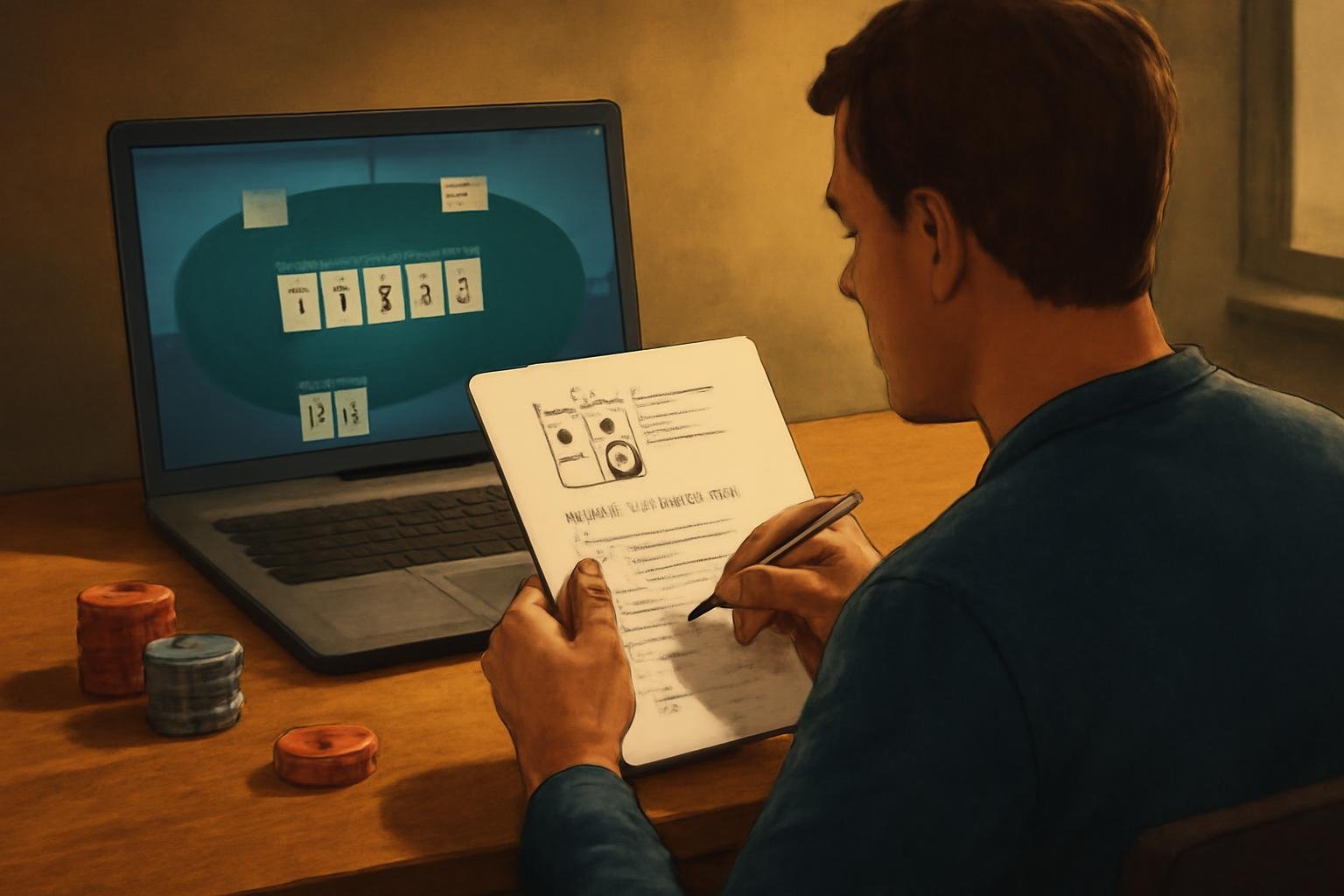
A hand can look obvious after the final card is dealt. That does not mean the decision was obvious when you made it. Reviewing poker hand histories is most useful when you separate what you knew at each decision from what you learned later. This practical process can help you spot recurring leaks without mistaking a bad result for a bad decision—or a lucky result for a good one.
Start with the decision, not the outcome
Before reading the showdown or checking who won the pot, pause at the first decision you want to examine. Cover or scroll past the later action if your poker client allows it. Write down the information available at that moment: your cards, position, effective stack, previous actions, and any reliable reads you had.
Then state the decision plainly. For example: “I had a medium-strength hand in position, faced a bet, and needed to choose between calling, raising, or folding.” Avoid writing “I should have folded because the opponent had a stronger hand.” That conclusion uses information you may not have had at the time.
Rebuild the hand street by street
Review each action in order and ask what changed. On a pre-flop decision, note the positions and the action before you. On later streets, consider the board, bet size, pot size, and how the earlier action shaped the situation. Keep your notes focused on decision factors rather than trying to guess an opponent’s exact cards.
- Pre-flop: What was your position, and what actions had already occurred?
- Flop: How did the board connect with the range of hands suggested by the action?
- Turn and river: Did the new card or bet change your assessment, or did you continue with your original plan automatically?
- Showdown: What did the revealed cards teach you—and what remains uncertain?
When estimating an opponent’s possible hands, use a range rather than assigning one exact holding. A showdown reveals one instance, not every hand that could have taken the same line. Treating the revealed hand as proof that your opponent “always” plays that way can lead to shaky conclusions.
Use a consistent review checklist
For each important decision, answer the same small set of questions. Consistency makes it easier to compare hands and notice habits over time.
- What was my goal? Was I betting for value, bluffing, protecting a hand, or calling to continue?
- What information supported the decision? Consider position, action, board texture, bet sizing, and known tendencies—not assumptions formed after the reveal.
- What alternatives were available? Compare the options you realistically considered, including checking or folding where appropriate.
- What would make me change my mind? Identify a specific opposing action, card, or read that would alter your plan.
- Was the process sound? Judge the reasoning with the information available, separately from whether the pot was won.
If you are still learning the game’s fundamentals, revisit the site’s guide to basic Texas Hold’em decisions. The purpose is not to copy a single rule into every hand; it is to give your review a sound vocabulary.
Separate process from results
A favorable result can conceal a questionable decision, while a losing hand can still contain a reasonable choice. In a game with incomplete information, one hand cannot establish whether a decision was consistently profitable. Record the reasoning and revisit similar situations later rather than letting one showdown settle the question.
A useful note might read: “Called the turn because I believed the opponent’s sizing included enough weaker hands; review similar calls against this line.” This is more actionable than “Bad call” or “Unlucky.” It also leaves room to update your view if further evidence suggests your assumption was wrong.
This distinction is closely related to the broader question of how luck and skill affect poker. Short-term outcomes can be noisy, so keep your review centered on repeatable reasoning, not on proving that you deserved a particular pot.
Watch for common review traps
- Outcome bias: Calling a decision correct only because it won, or incorrect only because it lost.
- Hindsight certainty: Acting as if the opponent’s revealed cards were predictable all along.
- Cherry-picking: Reviewing only dramatic hands while ignoring ordinary repeated decisions.
- Overconfidence in a read: Treating a small sample of observed behavior as a reliable pattern.
- Changing several things at once: Making it difficult to tell which adjustment helped your understanding.
For a practical next step, choose a few hands from one session that involved a decision you found difficult. Review them away from the table, write down your reasoning before looking at the result, and identify one question to study further. A focused review is more useful than replaying every hand without a clear purpose. Keep poker within a budget and treat it as entertainment, not income.